
Boy Scouts of America Composites Merit Badge - Frequently Asked Questions
(Click on the question for the response.
Is there a question you have that is not here? Email us at meritbadge@acmanet.org
and we will email you a response.)
General Questions
1. How much time is required for the
hands on projects?
2. Where can we find more information on manufacturing
with composites?
3. Does this merit badge require “hands-on”
activity with composite materials?
4. Are there any project suggestions for inland scout
troops that don’t have access to the ocean or making surfboards?
5. Are there any planned “Boot Camps”
or training sessions we can attend to prepare for the merit badge activity?
6. How many scouts are recommended at a time to perform
projects for this merit badge?
7. Are there composites industry events that Scouts
and their Counselors could attend to see products, meet companies and
view live demonstrations?
Materials
1. What materials are needed for this merit badge?
2. Where can we obtain these materials?
3. Are these materials safe?
Cost
1. Is this an expensive activity?
Safety
1. What special storage and handling precautions
are recommended?
2. What safety precautions do we have to be aware of
for the scouts and scout leaders?
3. Are resins safe for my son to handle?
4. Are glass reinforcements safe to handle?
5. Where can we do a composites project, a garage?
Experience
1. What experience level is recommended for counselors
and scouts?
2. Is this a heavy supervised activity?
Answers:
1. Obviously, this is project dependent. Our intention
is to put “step-by-step” instructions for the projects listed
in this website including approximate completion times. It is important
to note that before work begins, the entire project needs to be laid out
and every step considered. Safety is paramount. Working in an open area
is mandatory with no open flames. Please read all safety instructions when
planning your project.
Top
2. This BSA portion of the ACMA website is an excellent
source of information on general composites. The BSA manual does give the
basics of the hand lay-up procedure on page 58. Another avenue is to run
a search on the internet for instructions for manufacturing composites/fiberglass.
Such a search yielded these sites:
http://composite.about.com/od/howto/
http://www.voyageur-gear.com/downloads/care&repair/Composites_Repair_Guide.pdf
http://www.botsandbytes.com/HOW%20TO/fiberglass101.htm
Since we do not have control over these sites, we cannot guarantee the
accuracy of the content. We felt that there was enough useful information
on the sites to warrant their inclusion on this list.
Top
3. Yes. Requirement 5 in the Merit Badge Pamphlet
is to learn the techniques to work with resin and glass is an integral part
of the process for the merit badge.
Top
4. Interestingly enough, most of the Scouts that
participated in the Composites booth at the Boys Life pavilion during the
2005 National Scout Jamboree were “land-locked” troops. The
“Project ideas” section of this site lists several suggested
projects more applicable to your geography.
Top
5. This is a new badge and therefore this will be
new to all Scout Camps. The ACMA Composites Merit Badge Committee was formed
to assist Scouts and Counselors on a local level. We intend to work with
camps to set-up the composites badge. This will take time. Send an email
to meritbadge@acmanet.org with
your interest or contact your local council or Scout camp for times and
dates in your area.
Top
6. This merit badge requires the individual Scout,
working with their Counselor or instructor to make the project. Larger projects
could require more Scouts to build the project. In this case, a group of
Scouts could work on a project. The number of participants will greatly
influence the type of project selected. A troop project could yield a greater
number of participants. At the 2005 National Scout Jamboree, we had 8 Scouts
and 2 training personnel making the surfboard. This configuration allowed
for all to equally view and participate with plenty of ventilation under
a large tent.
Top
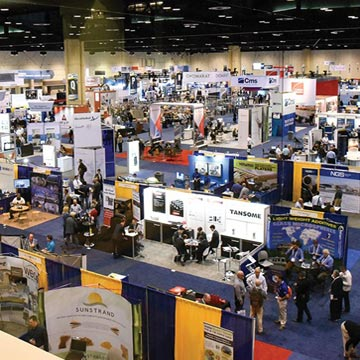
7. Yes. The ACMA has a yearly conference and EXPO.
In 2006, the conference will be held at the America’s Center in St.
Louis, MO from October 18-20. If you are interested in attending, please
visit www.acmashow.org. You may also
want to send an email to meritbadge@acmanet.org
to receive free show passes for interested parties.
Top
Materials
1. This is project dependent of course. Most smaller
projects can be done with the materials found in a standard “fiberglass
repair kit” found in hardware, sporting goods, automotive, boating
and hobby stores. A kit will normally consist of a quart to a gallon of
resin, fiberglass cloth or mat and the appropriate initiator.
Top
2. Since there are so many composite (fiberglass)
products, repair kits are found in several types of stores. Most smaller
projects can be done with the materials found in a standard “fiberglass
repair kit” found in hardware, sporting goods/surf shops, automotive,
boating and hobby stores. The best procedure is to call ahead to verify
that your intended store stocks this type of kit.
Top
3. Yes, with a warning. These materials are safe
when handled in accordance with the labeling on the packaging or the MSDS
(Material Safety Data Sheet). Proper ventilation (with appropriate mask)
with eye and hand safety is paramount for safe use of these materials. Please
read all instructions carefully. Also refer to the Merit Badge Pamphlet
for safe handling of materials.
Top
Cost
1. This is project dependent, of course. The standard
fiberglass repair kit found in hardware, sporting goods, automotive, boating
and hobby stores costs approximately $20 and could easily be shared with
other Scouts doing smaller/individual projects.
Top
Safety
1. The best answer for this question will be found
on the chemical packaging labels. All chemicals are required to include
safety and handling requirements. The Composites Merit Badge pamphlet also
includes a safety precautions section on page 43 and how to read MSDS sheets
on page 45. Please read all of the labels and safety instructions as you
plan the project.
Top
2. The Composites merit badge pamphlet has an excellent
section on safety precautions on page 43. Fiberglass work is definitely
smelly, tends to be messy and should not be done inside anyone’s living
quarters (including basements). The resins and initiators produce a smell.
The smell can remain there for days after the project is complete depending
on the ventilation in the work area. The fact is that prolonged exposure
to vapors is dangerous and should be avoided. Please make sure that there
is plenty of ventilation and work is done with a respirator, safety-rated
eye goggles and gloves. Any project must be done with a Counselor present.
Top
3. Resins are flammable liquids that need to be properly
stored and appropriately handled. Resins are packaged with all the necessary
guidelines for safe handling. The project must be completed in a well-ventilated
area with the Scout and Counselor wearing a mask, protective eye gear and
gloves. Be sure to read page 43 in the Composites Merit Badge pamphlet.
Of course, resins are a flammable liquid, and all work should be done in
an area without open flame or other heat source. Please be safe.
Top
4. Yes. Fiberglass can be safely handled with work
gloves. You should also use protective eyewear (safety goggles) and have
full body covering with long pants, long-sleeve shirt, etc. The fiberglass
used in these projects is similar to the fiberglass used in insulation.
Contact with bare skin normally creates an itch at the contact location
(from the small glass fibers). The itch can be lessoned if the exposed area
is washed with soap and water and properly dried.
Top
5. Yes, a small project can be done in a garage,
but with a warning. A garage that is well-ventilated (door/windows open)
would be an acceptable structure. DO NOT WORK WITH YOUR PROJECT IN A CLOSED
GARAGE! You may, however, want to consider putting some sort of barrier
(towels, rugs) between the garage and the door that leads to the home to
avoid the smell entering your living quarters.
Also, since you are working with flammable liquids, be sure to keep your
work area away from flames, including pilot lights. Other areas could include:
a. a large tent in an open field
b. contacting a local composites manufacturing facility and requesting to
use their facilities and (potentially) assistance from qualified personnel.
c. Boy Scout camp facilities that are supplied with the appropriate materials
Remember, the smell is substantial and it is not recommended that the project
be completed in or near living quarters.
Top
Experience
1. The BSA requires that a Merit Badge Counselor
have a working knowledge of the subject he is teaching. Counselor’s
should have a working knowledge, or even better, actual working experience,
with the hand lay-up manufacturing process.
Top
2. ABSOLUTELY! All projects must be done under
the supervision of a Counselor or instructor. Any activity involving chemicals,
flammability, hand tools, etc. should be heavily supervised. Please see
page 43 of the Composites Merit Badge pamphlet for safety recommendations.
Top
|