

|
Pulling Strings
By Monica Cardenas
Intense R&D keeps BAI on Cutting Edge of Unmanned Aircraft Systems
Interviewed:
Richard Bernstein, President
L-3 BAI Aerosystems
Easton, MD
CM: What is the nature of your business?
RB: BAI’s core business is in the design, manufacture, and integration
of unmanned aircraft systems (UAS). BAI offers a complete line of unmanned vehicles
and support equipment, and is also able to provide individual components for
an UAS.
CM: How many employees do you have?
RB: 75 employees involved in design, development, manufacturing, engineering,
integration, flight testing, administration, purchasing, marketing, sales, and
finance.
CM: What is your company’s background?
RB: BAI was started in Rockville, MD, in 1985, as an airframe manufacturing
company. In 1991, BAI was moved to its current facility in Easton, MD, and has
evolved into a single source for complete unmanned aircraft systems. In 2004,
BAI was acquired by L-3 Communications Corporation, the nation’s sixth-largest
U.S. defense contractor.
CM: How has it evolved from its beginnings?
RB: BAI was started solely as an airframe manufacturer, and has developed into
a complete UAS manufacturer. BAI has not just produced over 1,100 unmanned vehicles;
it has expanded its product line to include payloads, launchers, data links,
autopilots, ground control stations (GCS), remote video terminals (RVT), and
flight services. Through its refined manufacturing processes, BAI is now able
to manufacture individual parts or mass quantities, with the option of customizing
a product for its customer on short notice. BAI specializes in composite manufacturing,
and produces all of its products in-house.
CM: How did you get started in the industry?
RB: BAI was started by three individuals who had developed a new technology
for manufacturing airframes. This process of using composite material lightened
the weight of the airframe, and allowed for customized payloads to be integrated
with the airframe. When BAI’s former owner and current president moved
the company, BAI began to design and develop more subsystems, until reaching
its current peak of offering complete systems and flight services.
CM: What obstacles does your company face today in the regulatory or
technical arenas?
RB: The FAA regulates airspace, and receiving approval to fly within that airspace
has been a cumbersome and complex process. Commercial applications may require
airspace approval, but this is still an on-going task.
CM: What are your marketing efforts?
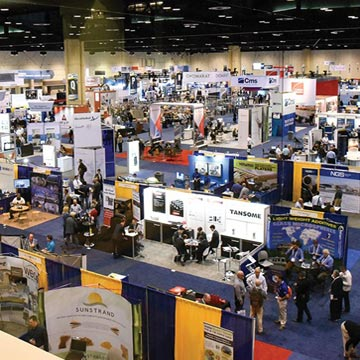
RB: BAI focuses on UAS-specific trade shows and literature, including the Association
for Unmanned Vehicle Systems International (AUVSI) and the Shephard Group. Both
associations provide domestic and international marketing opportunities, and
provide the largest industry base at trade shows. BAI has recently commenced
marketing in the international market, but this is also a developing area. As
a division of L-3 Communications Corp., BAI has access to a larger trade show
base, and has expanded its marketing presence to the U.S. military and their
main trade shows.
CM: What development or research would you like to see happen to improve
the industry?
RB: FAA regulations need to be made clear, and companies must be made aware
of the progress that is being made. Also, UAS technology improves on a daily
basis, and the exciting part of this industry is research and development. Certain
programs need collaboration from different companies, and the development of
written standards across the board would be welcome.
CM: Where do you see your business in five years?
RB: BAI has positioned itself to be an able provider of complete unmanned aircraft
systems, from design through deployment. As technology improves, BAI intends
to continue its role as a leading manufacturer of unmanned vehicles and support
equipment. With over 20 years of composite manufacturing experience, BAI is
now able to offer the necessary support for these products, and provides flight
services around the globe. The market for flight services is also growing, and
BAI foresees an integral role in that arena.
CM: How are you staying on the cutting edge?
RB: BAI’s engineering department is constantly researching ways to improve
its products, whether it be with a different material, a new process, a modified
version of a current product, an added feature to its plane, or the development
of an entirely new product. BAI is in constant contact with its customers, and
is in-tune to their needs. The flexibility of a company of our size allows BAI
to constantly update our products, and to adapt to meet the customer’s
requirements.
Monica Cardenas is the assistant editor of CM magazine. She can be reached
at 703.682.1651 or mcardenas@acmanet.org.
|